Learning
Research
October 29, 2026
Wingu News
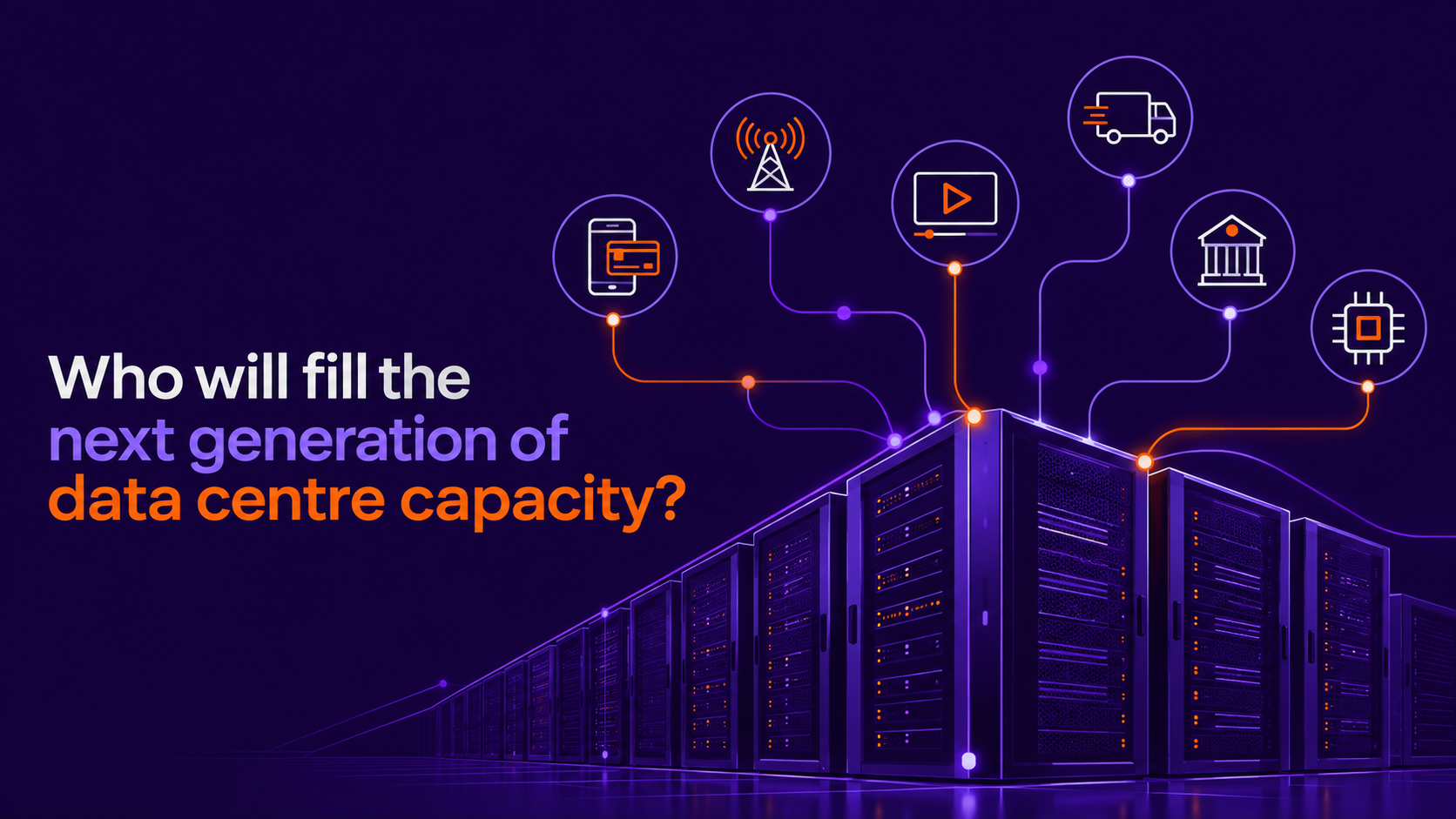
East Africa's next wave of data centre development will depend on more than cloud adoption and the arrival of artificial intelligence. Financial services, media platforms, logistics companies, online retailers, government agencies and manufacturers are all generating growing volumes of data, creating demand for infrastructure that can store, process and move information securely and reliably. The commercial opportunity for operators lies in understanding which industries are ready to move their workloads locally, what those customers require and how quickly their demand will translate into long-term capacity commitments.
A market moving beyond connectivity
Africa remains significantly underrepresented in the global data centre market, despite its large population and expanding digital economy. The Africa Data Centres Association's “Data Centres in Africa 2026: The Economic Report” estimates that the continent has approximately 360 MW of active capacity, just 0.6% of the global total. McKinsey's November 2025 analysis, “Building data centres for Africa's unique market dynamics”, estimates that African demand could rise from around 0.4 GW to between 1.5 GW and 2.2 GW by 2030.
That points to substantial potential but forecast demand and announced projects should not be confused with capacity occupied by paying customers. Growth will hinge on electricity availability, fibre connectivity, affordability, regulation and businesses' willingness to migrate workloads from overseas or privately operated facilities.
Fintech will remain a foundational customer
Financial technology is one of the clearest sources of demand. Digital payments, mobile money, online banking, lending platforms and payment processing all depend on continuous access to data, and providers need secure environments that can handle peak demand, maintain availability and support disaster recovery.
In Ethiopia, the continued development of digital financial services creates opportunities for locally hosted transaction systems, customer databases, fraud detection and regulatory reporting. Tanzania’s established mobile-money ecosystem and expanding digital commerce provide similar opportunities, while Djibouti’s position as an international connectivity hub may appeal to financial institutions serving cross-border businesses.
For these customers, proximity is only part of the decision. Security controls, compliance requirements and low-latency connectivity matter just as much. Financial institutions may also prefer hybrid architectures, keeping sensitive or latency-critical workloads close to their operations while using public cloud for selected applications.
Telecoms and satellite operators will anchor carrier-neutral facilities
Telecoms operators are likely to be among the most important tenants of carrier neutral facilities, and not only for their own equipment. Their networks carry the traffic that cloud, content and enterprise customers depend on, so a site hosting several operators becomes the natural meeting point for everyone who needs to reach them. An anchor tenant is ideal for the developer, since its commitment can underwrite the investment in a new facility from the outset. The wider value, however, lies in the commercial ecosystem created by a mix of tenants: each additional network makes the facility more attractive to the next customer, whether a bank wanting direct connections, a cloud provider seeking an on-ramp or a content platform caching closer to users.
Telecoms are also a more complex customer than they first appear. As operators modernise their networks and move more services onto cloud platforms, they generate steady demand for space, power and interconnection. But some also run their own data centre capacity, so neutral operators must show why a shared facility offers better economics, wider interconnection or faster deployment than building in-house.
Low Earth orbit (LEO) satellite services are adding a further source of demand as they extend across multiple African countries. Operators need well-connected locations to house ground station and gateway equipment, linking their networks to terrestrial infrastructure so that they can bring connectivity to under-served remote communities spread across vast regions with little physical infrastructure on the ground. Carrier neutral facilities with diverse fibre, reliable power and direct interconnection are well suited to that role.
Media, streaming and gaming will increase local traffic
Video streaming, social media, digital broadcasting and online gaming are changing the economics of internet traffic. High-definition video and interactive applications require significant bandwidth, while content delivery networks and caching systems reduce the distance data must travel between users and content providers.
This creates an opportunity for data centres that give content platforms a place to connect directly with the networks serving their users. When networks exchange traffic locally, providers can improve performance, reduce reliance on expensive international routes and offer a more consistent customer experience. Gaming adds another dimension as multiplayer services, digital distribution and cloud gaming become more accessible, although uptake depends on consumer spending, network quality and suitable payment services.
The opportunity is therefore not limited to hosting large streaming platforms. Content delivery, interconnection and regional traffic exchange can generate value from workloads that need relatively little server capacity but rely heavily on network performance.
Logistics and e-commerce need reliable digital foundations
East Africa's role in regional trade is another source of demand. Logistics businesses increasingly depend on digital systems for cargo tracking, fleet management, warehouse operations, customs documentation and cross-border delivery coordination, generating operational data that must stay available throughout the working day.
Djibouti, the maritime gateway for landlocked Ethiopia and, with its significant port infrastructure, a critical link for the wider East African market, shows how trade and connectivity can combine. The World Bank Group's September 2026 “Country Private Sector Diagnostic (CPSD)” identifies data centres as an investment opportunity alongside transport and logistics, and says existing capacity, supported by the country's international submarine cables, is nearing full utilisation. That makes new capacity important: Wingu Africa’s investment adds significant capacity in Djibouti, well placed to meet this potential demand and support the country’s continued development as a regional hub for trade and digital connectivity.
E-commerce has overlapping needs. Online marketplaces, payment gateways, inventory systems and recommendation engines must work together, especially during promotions and seasonal peaks. As retailers expand across borders, locally accessible cloud infrastructure helps them serve customers with more predictable application performance.
These sectors may not initially require hyperscale facilities, but their combined demand could support sustained growth in enterprise colocation, cloud hosting and managed infrastructure.
Government and SaaS will underpin recurring demand
Government digitisation can provide a strong foundation for local data centre markets because public services rely on large, persistent datasets. Digital identity, taxation, licensing, land administration, education and public health systems all require secure storage, backup and reliable access.
However, public-sector demand is not automatic. Procurement cycles, budget constraints, data protection requirements and decisions about data sovereignty all influence where workloads are placed and how quickly projects progress. Operators need to demonstrate value over the lifetime of a contract, not simply compete on price.
Software-as-a-Service providers offer a complementary opportunity. Accounting, enterprise resource planning, human resources, customer relationship management and industry-specific applications all generate recurring demand for compute, storage and backup. Local hosting helps providers serve customers that want predictable latency, local support or greater control over where information is stored. For operators, a common infrastructure platform can serve multiple SaaS businesses, with capacity growing as their customer portfolios expand.
AI will create demand, but power will determine its pace
Artificial intelligence is likely to become one of the most closely watched sources of future demand, although its impact will vary considerably. Businesses are already exploring AI for customer service, forecasting, fraud detection, document processing and operational efficiency. These applications need data and computing resources, but not all require expensive, power-intensive GPU infrastructure.
Over time, organisations may seek local environments for AI inference, model deployment and the processing of sensitive business information. More demanding training workloads could require specialist facilities with higher power densities, advanced cooling and substantial electricity supply, which conventional enterprise capacity cannot always accommodate without significant investment.
Policy is beginning to support this direction. Ethiopia's Digital Ethiopia 2030 strategy, launched in December 2025, identifies AI development, national cloud infrastructure and data governance as priorities. That creates a basis for future demand, though commercially viable AI workloads will turn on skills, investment, data availability and access to affordable computing. The sensible approach for operators is to prepare infrastructure that can adapt to changing requirements without assuming every customer needs large-scale AI computing immediately.
Digital health and manufacturing broaden the market
Digital health offers a different but potentially durable source of demand. Hospitals, laboratories, insurers and health technology providers are adopting electronic records, diagnostic platforms, telemedicine and digital patient management, all of which need dependable availability and safeguards for sensitive information. Adoption will be uneven where budgets, connectivity and skills remain constrained, but successful digitisation can create long-term requirements for secure hosting and backup.
Manufacturers are also becoming more dependent on connected systems. Enterprise resource planning, production monitoring, inventory management and predictive maintenance generate data across factories, suppliers and distribution networks. As industrial operations become more connected, downtime grows more costly, strengthening the case for disaster recovery and reliable hosting.
These industries are unlikely to fill new facilities on their own in the near term. Their value lies in diversifying the customer base, reducing reliance on a handful of large tenants and generating demand for a range of services, from colocation and cloud infrastructure to backup and managed security.
Turning digital growth into occupied capacity
The next generation of East African data centre capacity will not be filled by one industry or by AI alone. Fintech and telecoms provide the foundation, and every other sector discussed here broadens utilisation as organisations modernise and become more reliant on accessible data.
The challenge for operators is to convert these trends into signed contracts and sustained workloads. That requires resilient power, efficient cooling, strong security, diverse connectivity and the ability to scale without making customers pay for capacity they do not yet need. It also means supporting hybrid cloud models, enabling direct interconnection and helping businesses understand the practical benefits of local infrastructure.
Regional policy will matter as well. In June 2026, the East African Community advanced work on a framework for secure cross-border data flows, recognising that trusted movement of information is essential to digital trade. Better alignment could make it easier for businesses to operate across national borders while respecting data protection requirements.
Ultimately, the strongest data centre markets will combine credible demand with reliable infrastructure and competitive operating costs. For Wingu Africa, which secured US$60 million in June 2025 to support its East African expansion, the opportunity is to help these industries move from digital ambition to dependable, locally accessible computing capacity.
Learn more about us.