
Learning
Research
October 21, 2026
Wingu News
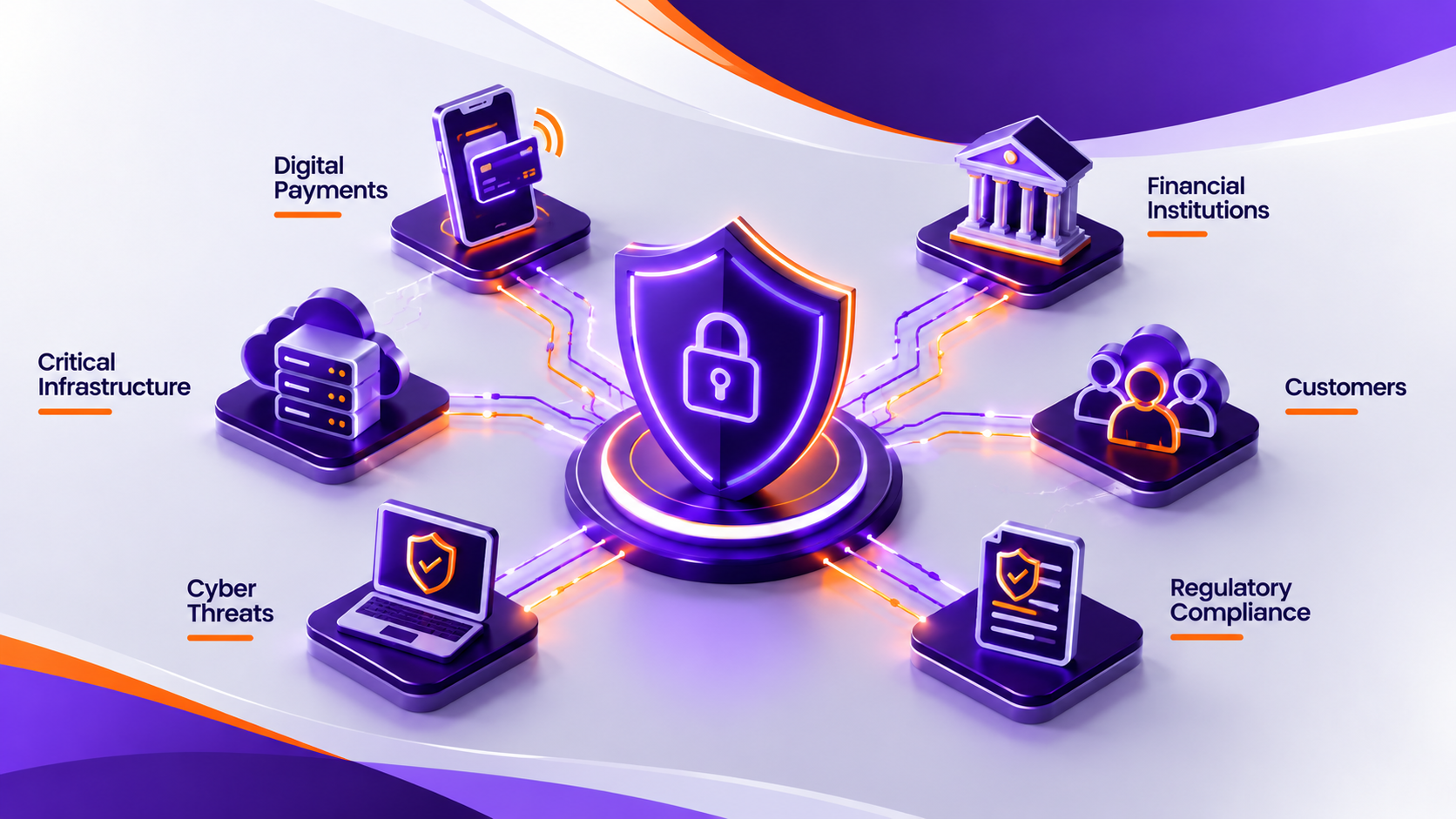
Tanzania’s financial sector increasingly runs on digital infrastructure. Mobile money, internet banking, electronic payments and fintech platforms have changed how businesses and consumers manage their finances, which makes the availability and security of these services essential to everyday economic activity. As institutions adopt new technologies, they also face more sophisticated cyber threats, including attacks that exploit artificial intelligence (AI).
The issue is gaining attention at the highest level. On 2 October 2026, The Guardian reported that the government had urged banks, insurers and technology companies to strengthen their cyber defences in response to AI-related risks. Speaking at the second Fortifying Finance Forum, government representative Macrise Mbodo called for stronger cooperation between regulators, financial institutions, telecommunications operators and technology providers, alongside investment in secure infrastructure and cybersecurity skills.
Protecting digital financial services takes more than keeping attackers out. Institutions also need infrastructure that can contain an incident, keep essential operations running and restore services quickly when something goes wrong.
AI raises the stakes
AI helps financial institutions detect suspicious transactions, analyse unusual behaviour and improve fraud detection. Cybercriminals can use the same technology to write convincing phishing messages, impersonate trusted individuals and automate parts of their attacks.
For banks, insurers and mobile money operators, the consequences go beyond stolen data. A compromised application could interrupt payments, expose customer records or cut customers off from essential services. Attacks on third-party suppliers add further risk, especially when several organisations rely on the same software, hosting environment or network connection.
The Bank of Tanzania’s National Payment Systems Annual Report 2025 reflects this. It describes continued expansion in digital payment services, including mobile banking, internet banking, card payments and cross-border transfers, and it flags rising cybersecurity threats to payment systems. As digital payments grow, so does the importance of the infrastructure beneath them.
AI should therefore be treated as both a security tool and a source of new risk, supported by governance, access controls and monitoring rather than used as a substitute for established practice. And because no preventive control stops every attack, resilience has to be designed in.
Designing infrastructure to contain an attack
Cybersecurity is often equated with firewalls, antivirus software and staff awareness, but the architecture of the IT environment matters just as much. Even with strong controls in place, a single compromised account or application can cause wide disruption if critical systems are not properly separated.
Network segmentation addresses this by dividing the network into zones and restricting communication between them according to operational need. A customer-facing mobile banking application, for example, should not automatically have unrestricted access to administrative systems, sensitive databases or backup environments. With separation in place, an attacker who compromises one application or account finds it much harder to move further, and the incident stays contained instead of affecting every service and complicating recovery.
Segmentation works best alongside multi-factor authentication, tightly controlled administrator accounts, regular security updates and continuous monitoring. Connections to external payment platforms also need careful management, with strong authentication and limits on what each connection can access.
Institutions should ask not only how an attack might be prevented, but how their infrastructure would behave if the first line of defence failed. That means understanding which applications depend on one another, where sensitive data is stored and whether critical services can keep running if part of the environment goes down.
The Bank of Tanzania has made a similar point at regional level. In February 2026, Governor Emmanuel Tutuba urged Southern African Development Community central banks to strengthen ICT security and operational resilience, citing increasingly sophisticated cyberattacks and the value of cooperation and information sharing for financial stability.
A tightening regulatory environment
Cybersecurity is also becoming a compliance matter. The registration period under the Personal Data Protection Act closed in early April 2026, with enforcement following. In August 2026, the Personal Data Protection Commission (PDPC) announced compliance inspections covering institutional registration, data protection officers, the handling and storage of personal information, and transfers of personal data outside Tanzania.
Data protection is now an operational question, not just a policy document. Institutions need to know what information they hold, who can access it, how it is protected and which service providers process it for them. Where cloud platforms or external hosting are involved, responsibilities should be clearly documented and backed by technical controls.
The Bank of Tanzania also published draft Cybersecurity Guidelines for Financial Service Providers in March 2026. Because they are drafts, institutions should verify their current status before treating them as binding. Even so, they signal the regulator’s direction, and they are a good prompt to review existing controls, identify gaps and confirm that technology arrangements support legal obligations.
Choosing hosting and connectivity with resilience in mind
Financial institutions may run applications from their own server rooms, colocation facilities, private clouds or public cloud platforms. Each model carries different responsibilities and risks. Colocation lets an organisation keep control of its hardware inside a professionally managed data centre, while cloud services offer flexible capacity and a range of built-in security tools. Neither is secure by default; the outcome depends on architecture, configuration, monitoring and a clear split of responsibilities between customer and provider.
When assessing a data centre or cloud provider, institutions should examine physical security, access controls, power resilience, network diversity, incident response and backup arrangements, and should establish how availability is measured and what happens when a component fails. Regional providers such as Wingu Africa, which offers colocation, cloud and connectivity services, are among the options worth evaluating against these criteria.
Connectivity deserves particular scrutiny. Two internet connections offer little protection if both follow the same physical route or depend on the same upstream provider. Real resilience comes from understanding these dependencies and planning how essential services will continue when a link fails.
Disaster recovery: planning for what prevention misses
Clear recovery plans should cover restoring applications, recovering transaction data and communicating with customers and partners. Two measures set realistic expectations: the recovery time objective (RTO), the target time for restoring a service, and the recovery point objective (RPO), the amount of data loss, measured in time, the organisation can tolerate. These will differ by application. A payment processing platform may need to be back far sooner than an internal reporting system, so priorities should reflect the operational impact of an outage.
Backups should be protected against unauthorised alteration or deletion, with isolated or immutable copies where appropriate. Recovery environments, such as a secondary site with a separate provider, should be sufficiently separate from production that a single compromised account or network cannot take out both.
Regular testing is what turns a plan into capability. Institutions should rehearse realistic scenarios, including ransomware, compromised administrator credentials and loss of the primary hosting environment, to confirm that systems can actually be restored within target times rather than merely that backup files exist. Business teams and external providers should be involved too, since restoring technology alone does not mean customers can safely resume transactions.
Building confidence as the sector digitises
AI will keep changing the threat landscape, and not every attack can be stopped. What institutions can control is how far an incident spreads and how fast they recover. Segmented networks, carefully chosen hosting and connectivity, and recovery procedures that have been tested rather than assumed all help protect customer confidence. Combined with cooperation across regulators, operators and technology providers, they put Tanzania’s financial sector in a stronger position as its digital economy grows.
Learn more about us.

