Learning
Research
November 26, 2025
Wingu News
Instant payments, big data and high availability are not abstract concepts for Ethiopia’s banking sector; they are the practical scaffolding on which the country’s financial modernisation will be built. In November 2025, EthSwitch, Ethiopia’s national payments switch, announced a strategic partnership with Mastercard to enhance the country’s digital payment ecosystem. This collaboration enables Ethiopian banks to issue globally accepted prepaid cards and connect more effectively with international payment networks.1 While this development highlights the country’s integration into global finance, it also underscores a pressing requirement for local banks: a robust, resilient, and high-performance data backbone capable of supporting instant payments, managing large-scale data flows, and ensuring continuous service availability.
Instant Payments: Transforming Customer Expectations
The National Bank of Ethiopia has prioritised the scaling of instant payments as part of its Digital Payments Strategy2, aiming to achieve interoperability across financial institutions, enhance settlement speed, and broaden merchant acceptance. Platforms such as Telebirr illustrate the rapid adoption of digital financial services, processing trillions of birr in transactions and serving more than 30 millions users.3 Customers now expect near-instantaneous transfers, seamless merchant payments, and a reliable service that is available around the clock.
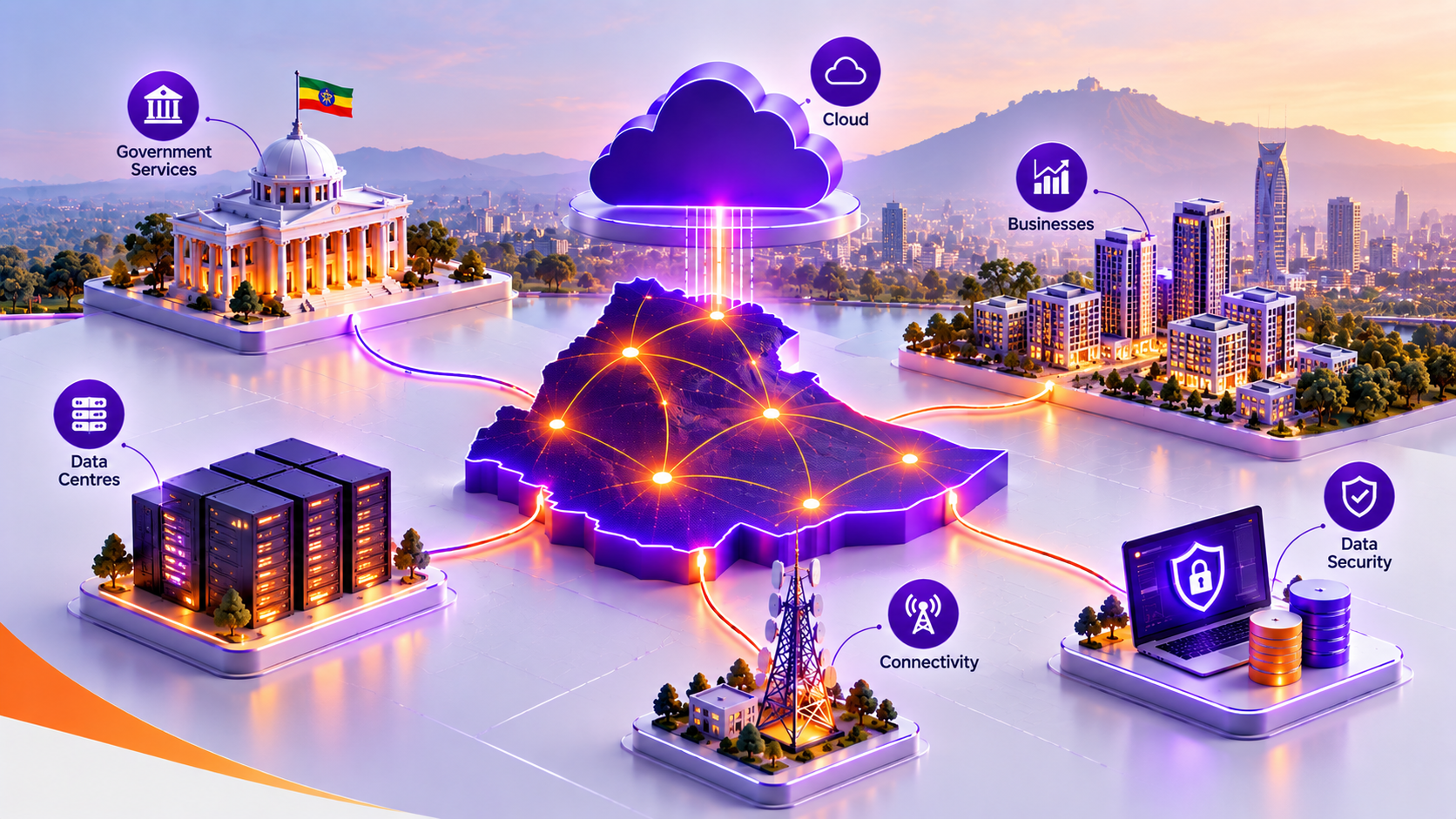
Delivering on these expectations requires backend systems capable of processing transactions with minimal latency. Traditional branch-centric IT infrastructures cannot support this demand. Instead, banks need centralised, cloud-ready platforms hosted in secure data centres featuring clustered databases (multiple servers working in parallel), synchronous replication (data instantly duplicated across geographic locations), and automated failover (switching to backup systems without manual intervention). This architecture ensures transactions flow smoothly even during peak demand or unplanned outages.
Big Data: Turning Transaction Volumes into Strategic Insights
Instant payments generate substantial transaction data, but real value emerges when banks harness this information for advanced analytics. Fraud detection systems can identify suspicious patterns as transactions occur. Credit scorers gain richer datasets for lending decisions. Anti-money laundering compliance becomes more accurate. Personalised customer offerings reflect actual behaviour rather than assumptions.
The critical insight: transaction velocity creates a virtuous cycle. High transaction volumes generate timely data, which enables real-time analytics, which supports faster decision-making, which drives further adoption. Supporting this requires scalable computing, distributed storage, and low-latency access while maintaining compliance with local data-residency regulations. A well-architected backbone enables institutions to monitor risks proactively, prevent fraud losses, and make informed credit decisions—directly increasing operational efficiency and customer trust.
Operational Resilience - A Non-Negotiable Requirement
High availability is not merely a technical preference; it is a strategic necessity. Customers expect 24/7 access to banking services, and any downtime can lead to financial losses, regulatory scrutiny, and reputational damage.
Ethiopia’s electricity network has expanded significantly in recent years, but variability in power reliability across regions remains a challenge. Banks must invest in data-centre infrastructure that includes backup power (uninterruptible power supply systems and generators), redundant sites across different locations, geographically distributed replication, and automated failover mechanisms. They also need redundant network connectivity to ensure uninterrupted service. These investments are substantial; a tier-3 secure data centre can require significant capital expenditure, typically 15-25 million USD4, but the cost of downtime far exceeds the cost of prevention. By embedding operational resilience into their infrastructure, financial institutions can maintain continuity under adverse conditions while reinforcing trust with customers and regulators.
Security and Compliance: Safeguarding Trust
As banks process ever-increasing volumes of sensitive data, security becomes paramount. The integration of local and international payment systems, as highlighted by the EthSwitch–Mastercard partnership, increases the exposure to potential cyber threats. Robust security measures must be an integral part of infrastructure design. Physical security, access controls, network segmentation, and continuous monitoring are essential to protect both customer information and operational integrity.
Secure connectivity between banks, payment processors, and international networks further reduces risk. Direct private links, as opposed to public internet pathways, can improve both security and performance for high-value transactions such as payment settlements and identity verification. In addition, auditability and comprehensive logging ensure compliance with regulatory requirements, enabling institutions to detect anomalies, investigate incidents, and demonstrate accountability.
Innovation: Building the Banking Services of Tomorrow
A strong, high-performance data backbone also creates opportunities for innovation. With reliable systems in place, banks can leverage instant payments and big data to develop new products and services. Co-branded prepaid cards, digital wallets, merchant lending solutions, and embedded financial services are all enabled by infrastructure that is scalable, secure, and always available.
By integrating analytics capabilities, financial institutions can offer personalised financial products based on customer behaviour and risk profiles. Real-time insights allow banks to proactively manage risk, optimise credit decisions, and enhance customer experiences. The infrastructure backbone thus becomes a strategic enabler, supporting not only day-to-day operations but also the creation of differentiated, value-added services that drive growth and financial inclusion.
Enabling Financial Inclusion
The expansion of digital payments and the integration with global networks provide a significant boost to financial inclusion. Co-branded cards connected to international payment systems offer customers, including previously unbanked populations, access to global commerce. Merchants, particularly small businesses and those in rural areas, can participate in digital trade without being constrained by cash-based transactions.
However, these benefits depend on reliable infrastructure. A strong data backbone ensures that payment services remain available, secure, and capable of processing high transaction volumes. In this way, infrastructure investment directly translates into broader participation in the digital economy, supporting both economic growth and inclusion objectives.
Conclusion
The EthSwitch-Mastercard partnership illustrates the potential for global connectivity and expanded financial services, but realising this potential requires investment in infrastructure that is reliable, secure, and scalable. Banks that prioritise data backbone development will not only meet customer expectations but also gain competitive advantage through risk management, operational efficiency, and the ability to innovate rapidly
In an era where digital payments drive economic activity, the institutions that move decisively on infrastructure will lead the market. Those that delay risk losing customers, reputation, and market share to competitors leveraging modern, resilient systems. By investing in a robust foundation today, Ethiopian banks can ensure they remain relevant, competitive, and trusted in the digital economy ahead.
Learn more about us.