Learning
Research
November 11, 2026
Wingu News
Ethiopia’s digital economy is growing at a time of heavy investment in electricity generation. For data centre operators, and the businesses that depend on them, there is still a gap between having access to electricity and having a supply that is reliable, stable and affordable enough for critical infrastructure.
As demand for cloud computing, digital payments, enterprise applications and data storage rises, the economics of building and running data centres will depend on more than the price of a unit of power. The quality of the connection, the resilience of the wider grid, the cost of backup systems and the efficiency of the facility itself will all decide whether an investment pays off over the long term. The task is to make good use of the power available, ride out interruptions without affecting customers, and expand in step with demand.
Electricity supply and the investment case
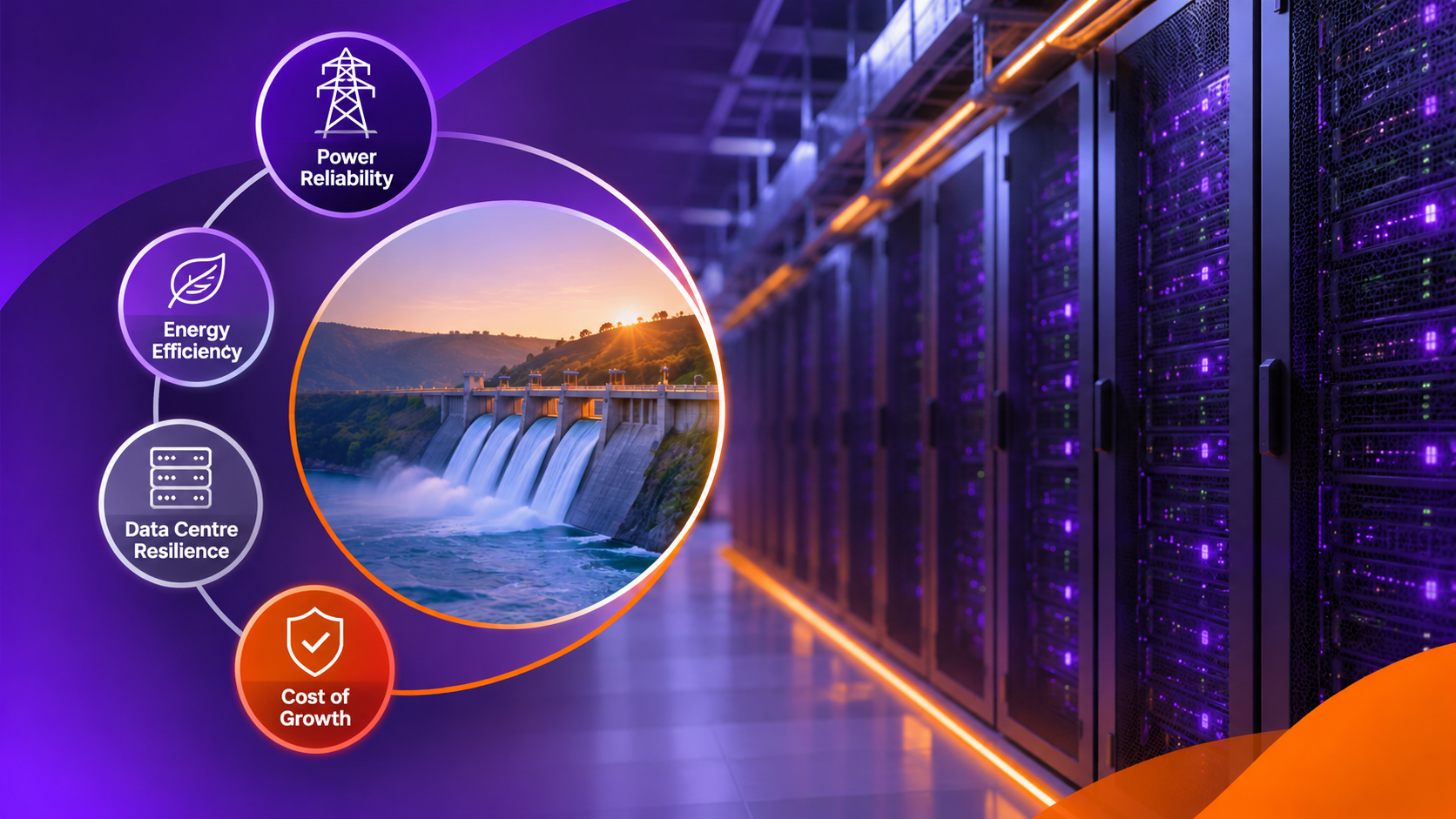
Hydropower remains central to Ethiopia’s energy system, and the country has invested heavily in it. The Grand Ethiopian Renaissance Dam (GERD), inaugurated as a completed project in September 2025, adds substantially to generation capacity and to Ethiopia’s longer-term ambitions for electricity supply and export.
Generating capacity, though, says little about what arrives at a particular building. Power has to be transmitted and distributed, and demand, maintenance and local infrastructure all affect the final connection. A country can add capacity without every industrial or commercial customer seeing an immediate improvement in supply quality.
For investors, this has direct financial consequences. A site with competitively priced electricity may still need significant spending on uninterruptible power supplies, standby generators, fuel storage, switching equipment and monitoring. How much depends on the grid connection, the workloads being hosted and the availability promised to customers. These costs sit alongside land, construction, cooling, connectivity and IT equipment. Underinvest in power infrastructure and the project may need more capital before it can carry its intended load. Overbuild for worst-case assumptions and the facility may carry costs that customer revenue cannot recover.
The sensible approach is to establish the real conditions at the proposed site and design resilience around the risks that actually apply there.
Power quality as well as continuity
Sensitive computing equipment needs more than electricity that is on for most of the day. It needs a supply that copes with interruptions, voltage fluctuations, frequency variations and changes in load without disrupting operations.
Reliability has three layers: how often and for how long the external supply fails; the quality of the power reaching the building; and the facility’s ability to keep running when the incoming supply drifts outside acceptable limits. Each calls for a different response. A short interruption can be covered by an uninterruptible power supply (UPS), which provides immediate battery power while another source comes online. A prolonged outage needs generators or other suitably sized backup generation. Voltage disturbances call for conditioning, protection and control equipment.
Design must also allow for maintenance and equipment failure. Redundant components lower the chance that a single fault stops service, but they add capital and operating cost, so their value depends on what is being hosted and what an outage would cost the customer. An enterprise running routine internal applications needs something quite different from a bank processing time-sensitive transactions. Starting from the business requirement and credible site-level power data, rather than defaulting to the highest level of redundancy, keeps the design proportionate.
The cost of backup power
Most data centre designs need backup power, and it comes with both financial and operational trade-offs. Generators, batteries, fuel systems, switchgear and controls all require upfront investment, followed by maintenance, testing, fuel and eventual replacement.
Where outages are rare, backup systems spend most of their time in testing, but they must still work the moment they are needed. Where outages are frequent or long, generators run more often and fuel and maintenance bills rise. Batteries need closer management too, since operating conditions and cycling patterns affect their useful life. Grid reliability is therefore an economic variable as well as an engineering one: two facilities with the same IT load can have very different running costs if one needs far more backup generation.
Investors should ask how much resilience is actually necessary, what it will cost over the facility’s life and how that cost will change as the business grows. That means assessing expected outage duration, fuel availability, maintenance arrangements and what happens if the switch between power sources fails.
Purchase price is a poor guide. A cheaper system may need more servicing or burn more fuel, while a well-specified battery and control system can cut generator runtime in some conditions. The right choice meets the required reliability standard at a sustainable total cost, which is not always the lowest initial price.
Energy efficiency and the cost of growth
A data centre’s electricity bill covers more than its servers, storage and networking. Cooling, power conversion, lighting and other building systems all draw power, and together they determine what each unit of computing capacity costs to deliver.
The most common yardstick is power usage effectiveness (PUE): total facility energy divided by the energy used by IT equipment. A PUE of 1.5 means that for every unit consumed by IT, the facility uses another half-unit on supporting infrastructure. Lower is generally better, though the figure only means something in context, including climate, utilisation, measurement boundaries and operating conditions.
In Ethiopia, the right efficiency strategy will vary with location, altitude, temperature, humidity, dust and water availability. These shape cooling design, filtration and the choice of heat-rejection technology, and no single cooling approach suits every site. Good design starts with realistic thermal modelling and equipment chosen for local conditions. Hot and cold air containment, sound airflow management and tight control of server inlet temperatures all cut wasted energy, and keeping hot and cold air from mixing matters most, because it lets cooling systems do their job without working harder than necessary.
How the IT estate is run matters as well. Underused servers still draw power, and poor capacity planning can leave equipment and cooling running outside their most efficient range. Consolidating workloads, raising utilisation and matching capacity to real demand can reduce consumption without a bigger building.
The benefits go beyond the electricity bill. Better efficiency reduces cooling needs, lowers the supporting electrical infrastructure required for a given IT load, and frees up capacity within existing power limits. That helps most where a site connection or backup system has little headroom, and it improves the economics of expansion.
Efficiency and resilience are separate goals, however. A highly efficient facility can still be at the mercy of an unreliable grid, and a resilient one can waste a great deal of energy if its cooling and electrical systems are badly run. Investment decisions need to cover both.
Hydropower, sustainability and operational resilience
Ethiopia’s hydropower offers a chance to run digital infrastructure on a comparatively low-carbon electricity system. In practice, the environmental and operational picture depends on actual generation, seasonal conditions, transmission capacity and whether power is available when and where it is needed.
A data centre therefore cannot assume that national capacity translates into uninterrupted, low-carbon power at its own connection, or that backup generation will be negligible because hydropower dominates the national mix. Its footprint depends on the electricity it really consumes, how its backup systems perform and how efficiently it operates.
A credible sustainability strategy pairs efficient design with careful measurement of consumption, cooling performance and generator runtime. Where feasible, operators can also look at renewable electricity procurement, suitable energy storage and arrangements that give better visibility of where and when their power is generated.
None of this means data centres will inevitably strain the power system. Their effect depends on scale, location, efficiency, load profile and how quickly supporting infrastructure develops. Planned investment can bring better electrical infrastructure and more efficient technology, provided new demand is assessed realistically and coordinated with the wider energy system.
Planning for sustainable digital growth
The next stage of Ethiopia’s digital infrastructure will depend on turning national electricity investment into dependable power for businesses and public services. That takes coordination between utilities, investors, telecoms providers, data centre operators and the organisations that will use the facilities.
Site selection should draw on evidence about grid availability, connection capacity, power quality, maintenance arrangements and the practical supply of backup fuel. Financial models should include tariffs, resilience spending, cooling energy, equipment replacement and plausible shifts in customer demand. Designs should allow staged expansion, so operators do not pay up front to serve workloads that have not yet arrived.
This is the thinking behind regional providers such as Wingu Africa, which operates across Ethiopia, Tanzania and Djibouti within the wider East African market for cloud and data centre services. For organisations deciding where to host critical workloads, local infrastructure is only as valuable as the reliability, connectivity, efficiency and operational discipline it delivers, whatever its proximity or nominal capacity.
Ethiopia’s growing electricity capacity is a real opportunity, and operators who treat efficiency, power quality and backup provision as linked investment decisions are best placed to avoid unnecessary costs. The strongest business case rests on measured local conditions, proportionate engineering and a clear view of what dependable service costs over the life of the facility.
Learn more about us.