Learning
Research
July 7, 2026
Wingu News
Since April 2026, Tanzania's Personal Data Protection Commission (PDPC) has moved into the enforcement phase of the Personal Data Protection Act (PDPA), introducing a new level of accountability for organisations that collect, process and store personal information. Much of the discussion around the legislation has focused on privacy policies, consent requirements and compliance procedures. But there is a more fundamental question underneath all of it: where does your data live, and is that location working for you or against you?
For organisations operating in an increasingly digital economy, compliance depends on more than documentation. It depends on having visibility into where information is stored, how it moves between systems, and whether the environments supporting critical operations are secure, resilient and properly managed. Increasingly, the answer for Tanzanian businesses is pointing toward infrastructure hosted closer to home.
Data protection starts with the infrastructure underneath
Data protection is often discussed in terms of policies and procedures, but those measures depend entirely on the technology environment in which data is stored and processed. Servers store information, networks move it between systems, backup platforms preserve it, and security controls protect it from unauthorised access. If those underlying systems are poorly managed or lack visibility, even well-designed policies become difficult to implement.
Many organisations have built their technology environments gradually. A new application here to support growth, a cloud service there to improve productivity, an external provider brought in for a specialised capability. Each decision solves an immediate problem, but the combined result is often a fragmented environment: a customer database in one place, business applications running through another platform, backup systems sitting somewhere else entirely. Without a clear infrastructure strategy, organisations can lose track of exactly how information flows across their own operations.
This matters more as regulators place greater emphasis on accountability. Organisations need to understand not just what data they hold, but which systems, providers and locations are involved in managing it, and that second question is increasingly a question of geography.
Why local infrastructure matters in Tanzania's digital economy
This is where the location of infrastructure stops being a technical detail and becomes a strategic one.
According to the Tanzania Communications Regulatory Authority (TCRA), internet penetration exceeded 85% during 20251. That level of connectivity means more always-on digital services such as payment platforms, customer portals, healthcare records, logistics systems, carrying larger volumes of personal data every day. Each of those services is a candidate for PDPA scrutiny, and each depends on infrastructure that can keep pace with the volume and sensitivity of what it's handling.
Local data centre infrastructure is well placed to meet that demand. By hosting critical systems closer to users, organisations can improve application performance and reduce latency, while also gaining more direct control over how their environments are managed and audited, a meaningful advantage when a regulator asks exactly where a dataset resides.
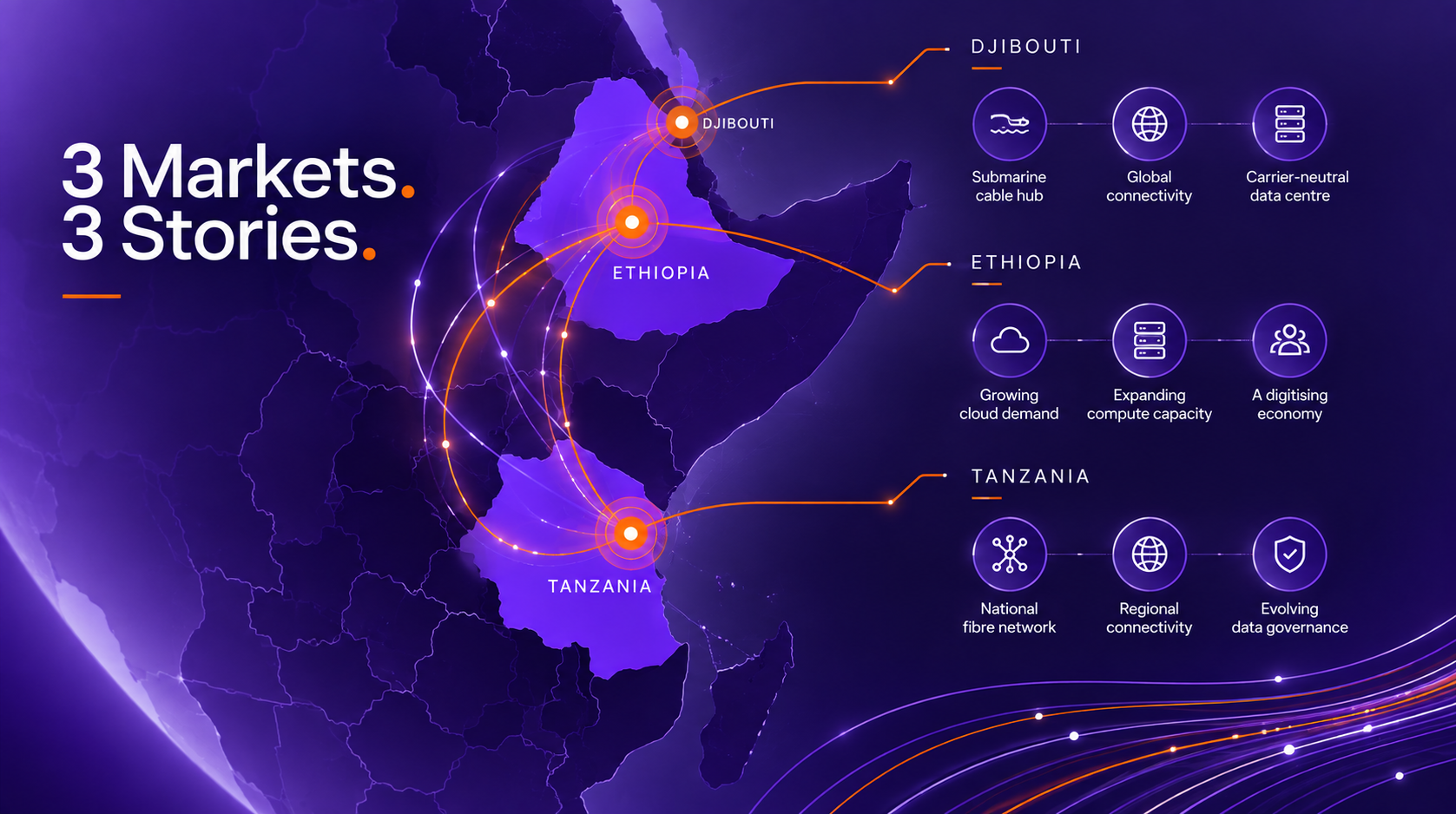
Wingu Africa's presence in East Africa reflects this shift toward locally available digital infrastructure. Through carrier-neutral data centre environments, organisations can connect to multiple network providers, cloud platforms and technology partners rather than being tied to a single ecosystem. For Tanzanian organisations, this offers a genuine alternative to relying solely on overseas hosting, while still allowing integration with global cloud platforms where that makes sense for the business.
Cloud adoption doesn't remove the need for local visibility
None of this is an argument against cloud computing. Cloud platforms have played a real role in helping organisations modernise, giving businesses access to enterprise-grade technology without heavy upfront investment, and letting applications scale quickly with demand.
But cloud adoption shifts where oversight is needed rather than removing the need for it. A modern enterprise environment may combine public cloud platforms, software-as-a-service applications, private infrastructure and third-party managed services, each with its own division of responsibility between the organisation and its provider. Without clear governance across that mix, it becomes harder to maintain consistent security standards or know precisely where a given workload, and the data inside it, is actually running.
The practical answer for most organisations is a hybrid model that puts each workload where it belongs. Applications that need flexibility and rapid scaling are often well suited to public cloud platforms. Sensitive workloads, customer databases and systems that require tighter control are often better served by locally hosted infrastructure, where the organisation has clearer line of sight over access, location and handling.
Resilience is a local infrastructure problem too
Data protection discussions tend to focus on confidentiality, but availability matters just as much. Businesses depend on their systems being operational when customers, employees and partners need them. A disruption to a payment platform, customer portal or internal application has immediate consequences: revenue affected, services interrupted, customer confidence damaged.
This is where locally hosted, professionally managed facilities earn their value most directly. Enterprise data centres are built around resilience; redundant power systems, multiple connectivity options, controlled physical access and continuous monitoring, and having that infrastructure close to the businesses and users it serves reduces the dependencies (undersea cables, cross-border routing, distant support teams) that come with hosting critical systems overseas. For organisations that cannot afford prolonged downtime, that proximity is not a convenience; it's part of the resilience itself.
Wingu Africa's carrier-neutral facilities are built around this principle: multiple redundant connectivity paths and direct access to a range of network and cloud providers mean that resilience isn't dependent on any single link or partner. For businesses weighing where to host sensitive or regulated workloads, that kind of built-in redundancy is as relevant to PDPA readiness as it is to day-to-day uptime.
Building the foundations for what comes next
PDPA enforcement arrives at a moment when Tanzanian organisations are already investing heavily in digital transformation; exploring artificial intelligence, expanding online services, using data analytics to sharpen decision-making. All of that increases reliance on infrastructure that is secure, scalable and, increasingly, local.
For companies reviewing their arrangements now, this is a chance to address problems that may have built up quietly over time: legacy systems, unclear hosting relationships, disconnected platforms scattered across providers and geographies. The organisations that get the most out of this regulatory shift won't simply be the ones that tick the compliance boxes. They'll be the ones that use it as a reason to understand their infrastructure more deeply, and to ask, plainly, where their data lives, and whether it should live closer to home.
As Tanzania's digital economy continues to grow, the strength and location of the infrastructure behind that growth will matter just as much as the services built on top of it.
Learn more about us.