Learning
Research
September 23, 2026
Wingu News
Ethiopia, Djibouti and Tanzania are taking very different routes towards the same destination: the infrastructure needed to support more data, more digital services and increasingly sophisticated technology.
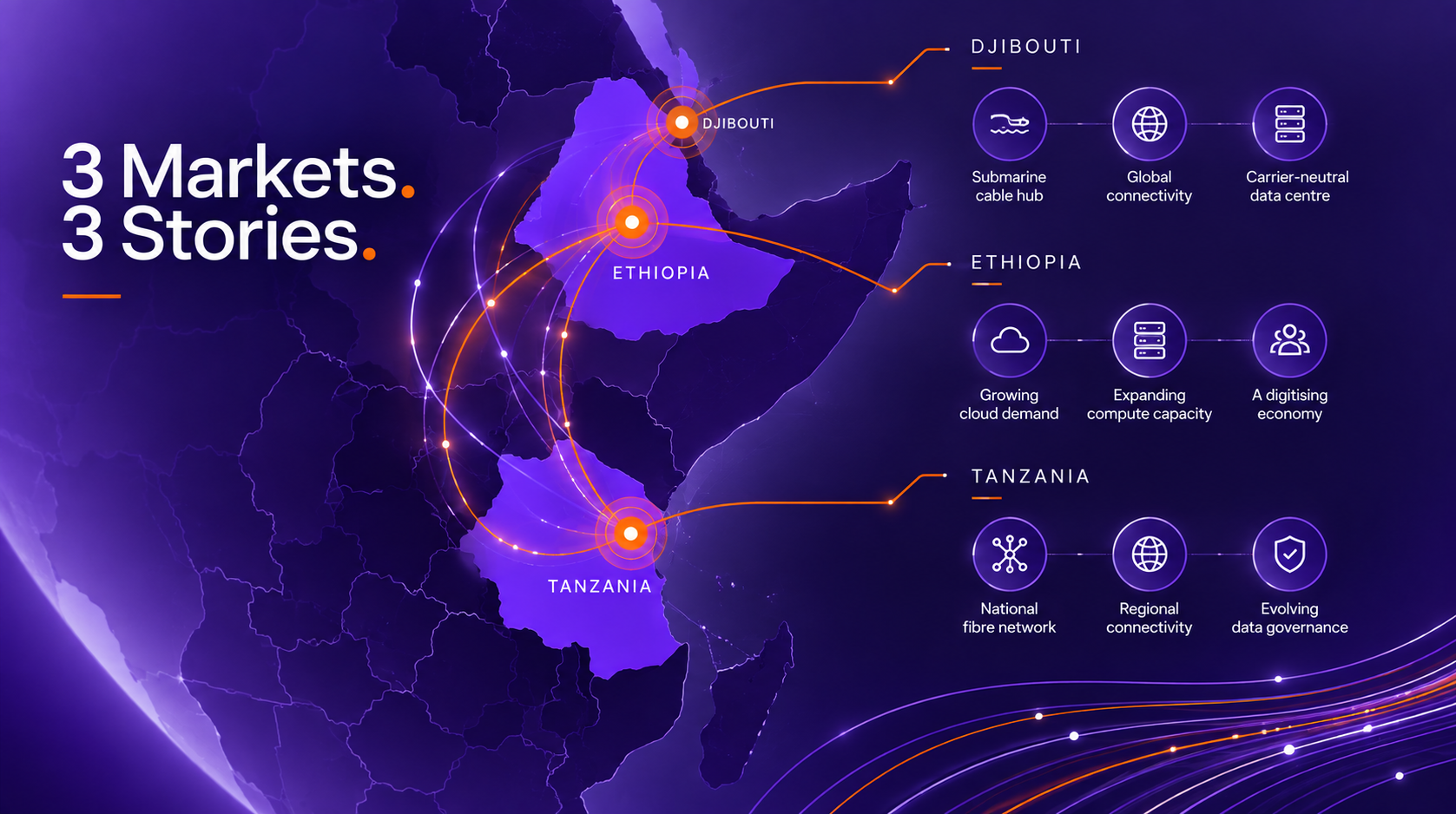
Ethiopia is focused on building the computing and cloud capacity needed to support a rapidly digitising economy. Djibouti's value lies in its geography. Multiple submarine cables make it an important international connectivity point, but historically it has lacked sufficient data centre capacity to capture more of the value flowing through those cables. Tanzania is developing a broader base, combining national fibre, international connectivity, data centres and new approaches to data governance.
These differences matter for businesses operating across the region. There is no single East African data centre or cloud market, and the priorities of a business in Addis Ababa may be quite different from those of one in Djibouti City or Dar es Salaam.
What is becoming clear, however, is that connectivity is only part of the equation. As businesses move applications to the cloud, governments digitise public services and AI creates demand for greater computing capacity, the physical infrastructure behind those services matters more. Where data is stored, where it is processed and how reliably it can be accessed are now practical business considerations, not just technical ones.
Ethiopia: More digital services mean more demand for infrastructure
Ethiopia's digital transformation has accelerated considerably in recent years. The opening of the telecommunications sector to competition has brought new investment, while falling data prices have brought more people and businesses into the digital economy.
Ethio telecom's results for the year to June 2026 show the scale of this change. Its customer base passed 90 million, while its mobile money platform, telebirr, reached 60.6 million customers and processed ETB 4.19 trillion in transactions during the year. Digital financial services demonstrate how quickly demand can develop once services become accessible.1
For the infrastructure sector, the more important question is what happens next. More users and more digital services generate more data, and that data has to be stored, processed and protected somewhere.
Ethio telecom's 2026/27 business plan provides a useful indication of the direction of travel. The operator plans to increase its data-centre IT capacity from 5 MW to 6.24 MW, expand elastic compute to almost 55,000 vCPUs and deploy 268 AI servers.2 These plans demonstrate the scale of computing demand emerging within Ethiopia as cloud services, AI and other data-intensive applications become increasingly important.
But meeting that demand does not have to mean relying on a single infrastructure provider.
This is where an open-access data centre model becomes increasingly important. Wingu Africa provides carrier-neutral, open-access data centre infrastructure in Ethiopia, giving enterprises, cloud providers, telecom operators and other digital businesses a place to deploy their own infrastructure and connect to the networks and services they need. Rather than tying customers to a single cloud or network provider, the model creates an environment where multiple providers can interconnect and compete.
The growing computing requirements being signalled by Ethiopia's largest digital service providers therefore point to a broader market opportunity: the need for independent, scalable infrastructure that can support multiple customers and technologies as the country's digital economy expands.
For organisations operating in Ethiopia, local computing capacity can reduce dependence on distant infrastructure, while local data storage can help manage requirements around security, resilience and data governance. International connectivity remains important for accessing global platforms and services, but proximity to high-quality, carrier-neutral infrastructure is becoming equally relevant.
The principal question in Ethiopia is increasingly one of scale: whether the country's physical digital infrastructure can keep pace with the demand being generated by its rapidly expanding digital economy.
Djibouti: Turning connectivity into digital infrastructure
Djibouti's position is fundamentally different. It is a small domestic market, but its geography gives it significance well beyond its population. Situated at the entrance to the Red Sea and close to major shipping routes, it has become an important landing point for submarine cables connecting Africa with Europe, Asia and the Middle East.
The World Bank Group's Country Private Sector Diagnostic, published in September 2026, puts the opportunity into perspective. Eight submarine cables are operational in Djibouti, while existing data-centre capacity has been described as nearing full utilisation. The report estimates that regulatory, energy and market-access reforms could unlock between US$160 million and US$240 million of private investment in data centres.3
That assessment describes the capacity that existed when the underlying market analysis was undertaken. The infrastructure landscape is already changing.
Wingu Africa has developed a new, large-scale data centre in Djibouti, adding significant new capacity to the market and creating infrastructure that is ready to serve customers. This changes the proposition for businesses looking to use Djibouti not simply as a cable landing point, but as a location for hosting, interconnection and digital services.
The distinction is important. A country can have excellent international connectivity without having sufficient local infrastructure to capture the full value of that connectivity. The arrival of additional data centre capacity means more of the traffic moving through Djibouti's submarine cable ecosystem can be connected, processed, stored and exchanged locally.
Wingu's open-access model is particularly relevant in this context. A carrier-neutral facility allows customers to choose their connectivity providers and establish connections between networks, cloud platforms and other digital services without being locked into a single operator. For a market whose strategic advantage is fundamentally built around international connectivity, that ability to interconnect openly is critical.
Energy remains one of Djibouti's most significant challenges. Commercial electricity tariffs are around US$0.25 per kilowatt-hour, compared with an African regional average of about US$0.14. For data centres, which operate continuously and have significant power requirements, that difference directly affects operating costs. Energy efficiency is therefore particularly important, while off-grid solar could become more relevant, with around 10 MW of private capacity deployed since 2022.4
Djibouti's story is therefore evolving. Its location brought the cables, but new data centre capacity can help turn that connectivity advantage into a broader digital services ecosystem. With Wingu's new facility now providing additional capacity, businesses have a new infrastructure option in a market strategically positioned between Africa, Europe, Asia and the Middle East.
Tanzania: From national network to regional infrastructure
Tanzania is developing a different kind of digital infrastructure story. Its domestic market is sizeable, its national fibre network is extensive, and its position on the Indian Ocean gives it direct access to international submarine cable systems.
According to a May 2026 statement from the ministry responsible for communications, the National ICT Broadband Backbone extended for 15,167 kilometres as of December 2025, connecting all mainland regional headquarters and seven neighbouring countries.5
International connectivity is also becoming increasingly important. Tanzania currently has three active submarine cables, and all three are present at the Wingu facility in Dar es Salaam. This concentration of international connectivity within a carrier-neutral data centre creates an important interconnection point for businesses that need access to multiple networks and international routes.
The combination of submarine cable access and carrier-neutral data centre infrastructure is significant. Businesses do not simply need a cable landing; they need somewhere to connect to that capacity, exchange traffic, deploy equipment and access multiple connectivity providers. Having all three active submarine cable systems present at the Wingu facility creates a platform for that interconnection.
Demand is rising quickly too. TCRA reported 62.79 million internet subscriptions in June 2026, while data traffic reached 1,041 petabytes in the quarter, up almost 12% on the previous quarter.6 As more services move online, businesses and public institutions need consistent performance, security and availability, not just access to a network.
Tanzania is also putting greater emphasis on how data itself is managed. In March 2026, the United Nations Economic Commission for Africa reported that Tanzania had validated its Electronic Data Governance Strategy, which covers data sovereignty, privacy, security, interoperability and data lifecycle management. The regulatory framework for data centres is developing alongside it. TCRA published minimum technical specifications for public data centres in May 2025, and the Public Data Centres Rules followed in March 2026, covering licensing, carrier-neutral data centres, personal data protection, backhaul services, information retention and technical requirements.7
For businesses, this matters because infrastructure decisions now sit alongside questions of governance. Choosing where to host an application is no longer solely a matter of price or technical performance: security, resilience, data location and the regulatory environment all play a part.
Tanzania is therefore building an ecosystem in which connectivity, data centres and data governance are increasingly linked. With three international submarine cable systems available within the Wingu facility, the market also has the infrastructure needed to connect domestic requirements with international networks.
What the three markets tell us about East Africa
Taken together, the three markets show that there is no single infrastructure model for East Africa, and that this may be one of the region's advantages.
Ethiopia's task is to build capacity at scale for a fast-growing domestic digital economy. The demand signals from major digital service providers point to rapidly increasing requirements for compute, cloud and data infrastructure, creating an opportunity for open-access facilities that can support a wide range of customers and providers.
Djibouti's opportunity is different. Its strategic advantage comes from the international traffic already passing through the country, while new infrastructure such as Wingu's data centre adds the capacity needed to capture more value from that connectivity. The market is moving from a story primarily about cable landings towards one that also includes hosting, interconnection and digital services.
Tanzania sits somewhere between the two, combining domestic scale and international connectivity with a policy framework increasingly focused on data governance and resilience. With all three active submarine cable systems present at the Wingu facility, the country also has an important foundation for international interconnection.
There is, however, a common issue across all three: computing capacity is becoming as important as connectivity. The World Bank's 2026 work on AI infrastructure describes four foundations countries need to develop AI capabilities: connectivity and reliable power, computing capacity through data centres and secure cloud, relevant data, and the skills to use these technologies effectively. The point is relevant well beyond AI, since the same foundations underpin cloud services, digital financial platforms, government systems and enterprise applications.
This is why regional data centre capacity matters. Businesses may use international cloud platforms, local providers or a combination of the two, but they still need reliable physical infrastructure somewhere. As workloads become more sensitive to latency, availability and data location, proximity becomes increasingly relevant.
For a regional provider such as Wingu Africa, this means understanding the differences between markets is as important as understanding the technology. Infrastructure designed for Ethiopia cannot simply be replicated in Djibouti or Tanzania without considering the different requirements around connectivity, energy, regulation, customer demand and regional interconnection.
For businesses, the decision about where to host workloads, establish disaster recovery, connect to cloud platforms or locate critical data needs to reflect the characteristics of each market. Open-access, carrier-neutral infrastructure can give those businesses greater flexibility by allowing them to choose how they connect and which providers they use.
East Africa's digital infrastructure will not be built through connectivity alone. It will depend on the combination of fibre, submarine cables, data centres, cloud platforms, power, cybersecurity, data governance and the skills to operate them.
The interesting question over the coming years is therefore not whether Ethiopia, Djibouti and Tanzania will become more digital, as that process is already underway. It is how effectively each country can build on its strengths, address its constraints and connect its digital ecosystem to the wider region.
That will determine not only where East Africa's data is stored, but also where the economic value created by that data is captured.
Learn more about us.